US
 Australia
 United Kingdom
 Europe
Camber Bolts for 2007 Honda Element EX
IMPROVE GRIP, HANDLING & PERFORMANCE.
Nolathane camber bolts give you a simple, bolt-in way to correct wheel camber where your Honda Element's factory suspension has little or no adjustment. A camber bolt replaces a standard mounting bolt at the strut or control arm, and its offset design lets an alignment technician move the top of the wheel inward or outward until the tire sits fl... Read more
Nolathane camber bolts give you a simple, bolt-in way to correct wheel camber where your Honda Element's factory suspension has little or no adjustment. A camber bolt replaces a standard mounting bolt at the strut or control arm, and its offset design lets an alignment technician move the top of the wheel inward or outward until the tire sits flat on the road.
Camber bolts, also called camber adjustment bolts, are a common fix after lifting or leveling a truck, lowering a car, or replacing struts and bushings that leave the wheels leaning slightly out of specification. Set correctly, they restore even tire wear, straight tracking, and confident grip. Each listing shows the bolt diameter, mounting position, and kit contents so you can confirm the fit for your Honda Element.
How Honda Element Eccentric Camber Bolts Work
A standard suspension bolt clamps two parts together in one fixed position. A camber bolt, also known as a cam bolt or eccentric bolt, adds a small, controlled range of movement to that joint.
Most designs create the offset in one or both of these ways:
- An eccentric shank, where part of the bolt body is offset from its centerline
- A cam washer, an offset washer keyed to the bolt so it turns with it
The bolt passes through a mounting hole that is oversized or slotted. When the technician rotates the bolt, the offset pushes or pulls the knuckle or arm a short distance across that hole. Moving the top of the wheel inward adds negative camber, and moving it outward adds positive camber.
Some applications need the factory hole slotted during installation, which is a job for a shop with the right tools, because a rough hole lets the joint shift under load.
Camber bolts hold their setting through clamping force alone. On control arm mounts, a cam bolt often changes caster at the same time as camber, and any camber change can shift toe. That?s why the adjustment always finishes with a full wheel alignment.
Honda Element Strut and Control Arm Mounting Positions
Camber bolts are made for specific mounting positions, and the position decides how the adjustment behaves.
Strut-to-Knuckle Camber Bolts
On many cars and crossovers with strut suspension, the strut bolts to the steering knuckle or rear hub carrier with two bolts. Replacing one of them, usually the upper bolt, with a camber bolt lets the knuckle pivot slightly on the other bolt and tilts the wheel?s upper edge inward or outward. This strut-to-knuckle mount is used on both front and rear axles, and it typically gives a modest range of correction.
Control Arm Cam Bolts
Many trucks and SUVs with independent front suspension use cam bolts at the upper or lower control arm pivots, where the arm mounts to the frame. Moving the front and rear pivots of the arm by different amounts adjusts caster, while moving both by the same amount adjusts camber. Because both settings live at the same bolts, a technician sets camber and caster together.
When Honda Element Camber Bolts Are the Right Fix
A camber bolt is the right tool when the error is small, the suspension parts are straight, and your Honda Element has a strut or arm mount that can take one. Good candidates include:
- Trucks with a mild lift or leveling kit whose readings sit just past the factory limit
- Cars on lowering springs that need a little more adjustment to take out excess negative camber
- Strut replacements, where normal tolerance in new parts leaves one side slightly off
- Vehicles with no factory camber adjustment that show edge wear on otherwise healthy tires
If an alignment printout shows only a fraction of a degree to recover, a camber bolt is usually the quickest and least invasive answer.
Adjusting Honda Element Camber Bolts at the Alignment Rack
Camber bolts for alignment work are set on a rack at normal ride height, never by eye. As a general guide, here?s how to adjust camber bolts on the front or rear:
- Install the camber bolts in place of the factory bolts and tighten the nuts until they are snug but still let the bolt turn.
- Lower the vehicle onto the alignment rack and settle the suspension at ride height.
- Read the current camber, caster, and toe on the alignment equipment.
- Rotate the cam until camber reads within specification, holding the bolt head so the setting doesn?t move.
- Check caster and toe, and adjust them as required, since a camber change can affect both.
- Torque the nuts to the vehicle manufacturer?s specification while holding the cam in position.
- Re-read the alignment to confirm nothing moved during tightening, then road test the vehicle.
Toe is the final adjustment on almost every alignment, so front camber bolts are set before toe. On control arm cam bolts, camber and caster are dialed in together before moving on to toe. A cam that turns while the nut is tightened is the most common reason a fresh alignment comes back out of specification, so hold the bolt head firmly throughout.
Honda Element Handling and Tire Life Gains
The payoff from a well-set camber bolt shows up every mile. With the tire standing square, the whole tread shares the load, so braking feels consistent and your Honda Element turns in cleanly instead of rolling onto one shoulder of the tire.
Matching camber side to side matters just as much. A difference between left and right makes the vehicle drift toward the side with more positive camber, and correcting it takes the effort out of holding a straight line. Tires that wear flat across the tread also stay quieter and last closer to their rated life.
Choosing Camber Bolts for Your Honda Element
The right camber bolt depends on where it installs and how much correction your Honda Element needs. Each listing shows the bolt diameter, mounting position, and contents, so check these points before you order.
Bolt Diameter
The shank of a camber bolt is machined to suit one bore size, so it has to match the bolt it replaces. A bolt that is too small for the hole lets the knuckle rock, and one that is too large simply won?t go through.
Hardware Grade and Locking Nuts
Look for heat-treated, high-tensile steel and a self-locking nut. The nut is part of what holds the cam in place, and many locking nuts are designed for one use, so a replacement belongs in the toolbox for any later adjustment.
Adjustment Range Required
Aim to land the setting near the middle of a bolt?s range rather than at its limit. That leaves room for later fine-tuning, for example after new tires or further suspension work, without having to change parts again.
Kit Contents and Quantity per Vehicle
A camber bolt kit generally includes the eccentric bolt, one or more cam washers, and a nut. Some kits cover one side and others cover both, so each listing shows the contents and how many are needed per vehicle. Adjusting both sides helps keep left and right camber matched.
Fitting Camber Bolts Safely on Your Honda Element
Camber bolts help locate the wheel on the vehicle, which makes this a job best handed to a qualified technician with an alignment rack.
Swap one bolt at a time on a strut-to-knuckle mount, so the knuckle never hangs loose. Seat any cam washers in their guides before tightening, and never run the nut down with an impact wrench, which can spin the cam past its setting. A factory bolt that has been torqued before may have stretched, so it goes in the scrap bin rather than back on the vehicle. Check the torque and readings again after the first drive.
Limits of Camber Bolts on the Honda Element
Camber bolts are a precise fix, not a cure-all, and it pays to know where they stop:
- Each bolt offers only a modest amount of travel
- A slotted factory hole is a permanent change to that part
- Bent knuckles, struts, or arms still need replacing, because the bolt only hides the error
- Loose ball joints or bushings let the wheel move, so the reading won?t stay put
- A cam left short of full torque can creep under hard braking and lose its setting
When the shortfall is larger than a bolt can cover, or there?s no mount to accept one, adjustable arms or strut-top camber plates take over. Shops may also adjust camber without camber bolts through factory shims or slotted mounts on some vehicles.
State Rules and Insurance
Camber bolts rarely raise inspection questions on their own, but the lift or lowering that made them necessary can. Ride height and equipment rules differ between states, so confirm your Honda Element meets the requirements where it is registered, and let your insurer know about the modification.
Warranty and Support
Nolathane camber bolts are backed by Nolathane?s warranty, which covers defects in how the part was made and the materials used. If you aren?t sure which bolt diameter or mounting position your Honda Element uses, our local support team can talk it through with you before you order.
Shop Camber Bolts for Your Honda Element
Camber bolts are one of the fixes in Nolathane's alignment parts selection.
Choose the camber bolts listed for your Honda Element and they?ll ship fast. Every order is covered by our fitment guarantee, which is matched to the listed bolt diameter and position, and returns are easy if the bolts turn out not to be needed.
1 item
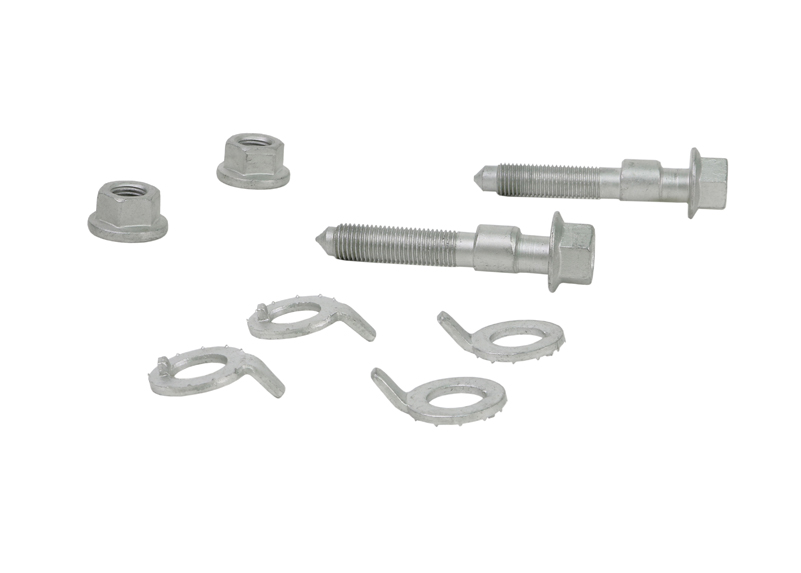
Front Camber Adjusting Bolt - Kit 16mm
✅ Fits 2007 Honda Element EX In StockShips within 24hrs.Ships within 24hrs.SKU: REV252.0012Front Camber Adjusting Bolt - Kit 16mm
✅ Fits 2007 Honda Element EXℹ️ Adds +/- 1.5 deg camberIn StockShips within 24hrs.Ships within 24hrs.Qty Required 1$49.87
Your vehicle
Matching vehicles
No match — try selecting it below.
Refine your search
Clear allNo categories match.
Can’t find what you’re looking for?
Our team can help you find the right part — or tell us what was missing so we can improve the site.
Call Us +1 909-476-2860 Give Feedback (opens in a new tab)