
 US
 Australia
 United Kingdom
 Europe
Control Arms for 2016 GMC Canyon SLT
IMPROVE GRIP, HANDLING & PERFORMANCE.
A control arm is the hinged link connecting your GMC Canyon chassis to the hub that carries the wheel. It pivots on bushings at the inboard end, attaches to the knuckle through a ball joint at the other, and holds the wheel in the position your alignment set while the suspension moves through its travel. Very little else underneath your GMC Cany... Read more
A control arm is the hinged link connecting your GMC Canyon chassis to the hub that carries the wheel. It pivots on bushings at the inboard end, attaches to the knuckle through a ball joint at the other, and holds the wheel in the position your alignment set while the suspension moves through its travel.
Very little else underneath your GMC Canyon has as much influence over how it steers, stops and wears tires.
What Is a Control Arm on Your GMC Canyon and What Does It Hold
Picture the arm as a hinge with the wheel hanging off the end of it.
The inboard end bolts to the chassis or subframe through bushings that allow the arm to swing vertically while resisting movement in every other direction. The outboard end connects to the steering knuckle through a ball joint, which allows the hub to pivot as you steer and articulate as the suspension travels.
Between those two ends, the suspension control arm has to hold the wheel against braking force pushing it rearward and cornering force pushing it sideways, every single time you use the vehicle.
A strut suspension usually has one front control arm per side at the bottom, because the strut takes care of locating the top of the knuckle. A double wishbone layout has an upper and a lower working together. At the rear, a car control arm turns up as a lateral arm, camber arm, toe arm or trailing arm depending on what it holds, and a rear control arm does a related job to a front one without being interchangeable.
Stamped, Forged and Aluminum GMC Canyon Control Arms
Construction varies more than most people realize, and it changes how the arm fails and what your options are when it does.
Stamped steel arms are pressed from sheet and welded, which is cheap to produce and perfectly adequate when new. They are also the ones that rust from the inside out, because water enters the welded seam and sits there. A stamped arm can look presentable from below and be badly corroded inside the section.
Forged steel arms are considerably stronger and hold up structurally for the life of most vehicles, with the bushings and ball joint wearing out long before the arm does. These are the best candidates for rebuilding rather than replacing.
Cast and forged aluminum arms turn up increasingly on modern vehicles for weight reasons. They do not rust, and they are also less forgiving. Aluminum does not tolerate the press loads involved in bushing replacement the way steel does, which is why manufacturers frequently supply these as complete assemblies with no serviceable parts at all.
Knowing which you have before ordering saves buying a bushing kit for an arm that will not accept one.
Why Some GMC Canyon Control Arms Cannot Be Rebuilt
Three things determine whether you replace a bushing or the whole arm.
The first is whether the ball joint is serviceable. Where it bolts in, it comes out on its own and the arm stays. Where it is pressed or riveted in, replacing a worn control arm ball joint means pressing it out with correct tooling or buying the assembly, and on plenty of vehicles the assembly is the sensible route once you count the time.
The second is the condition of the mounting eye. A bore worn out of round will not retain a new bushing no matter how carefully it goes in, and that is an arm replacement regardless of what the bushing costs.
The third is the material and design, which is where aluminum arms and some stamped assemblies simply do not offer a path back. If the manufacturer never intended the bushing to come out, forcing the issue usually ends with a damaged arm.
Check all three of those before ordering anything, because the cheapest repair is only cheap if the arm will actually accept it.
GMC Canyon Upper Control Arm Bushings and Lower Control Arm Bushings Wear Differently
The two positions do not fail on the same schedule, which is worth knowing before you order both.
A lower control arm bushing takes vehicle weight on most designs, because the spring sits on the lower arm. It also takes braking load directly through the same pivots, and that combination means the lower arm is usually the one showing symptoms first, and the front lower control arm is the hardest working of all four corners.
An upper control arm bushing carries less vertical load and more twisting load. On the designs that use them, the upper arm's ball joint tends to fail before its bushings do, which reverses the usual pattern.
Some trucks turn that on its head entirely by placing the spring or torsion bar on the upper arm, which makes the upper the loaded position and the first to wear.
The practical point is to inspect rather than assume. Replacing an upper arm because the lower one failed, or the other way around, is a common way to spend money without fixing the complaint.
Bad GMC Canyon Control Arm Symptoms
- A dull clunk or thud from the front over expansion joints and driveways
- A single knock as you take up drive or release the brake at a stop
- Steering that wanders and needs constant small corrections
- Pulling to one side under braking
- Shudder or vibration through the wheel when braking from speed
- Tire wear on the inside edge that keeps coming back after alignments
- An alignment that will not hold spec between services
- Visible cracking or separation in the control arm bushing material
- A torn ball joint boot, or grease thrown around inside the wheel
- Corrosion, flaking or perforation visible on a stamped steel arm
Bad control arm symptoms develop gradually, which is why most drivers adapt without noticing until something starts making noise. By then the tires have usually been paying for it for a while.
A Broken Control Arm on Your GMC Canyon: What Actually Happens
Worth understanding, because it is rare but not unheard of and the consequences are severe.
If a control arm fractures or a ball joint separates, the knuckle loses its connection to the chassis at that point. The wheel folds inward or outward under the vehicle, the brake line and any wiring to that corner are stretched or torn, and steering control at that wheel is lost immediately.
It happens at whatever speed you were traveling, without warning, and it is the reason a control arm with genuine play is treated as an inspection failure rather than an advisory.
The causes are almost always foreseeable in hindsight. Heavy corrosion on a stamped steel arm, a ball joint that has been running with a split boot for years, or an impact that cracked the arm without anyone noticing. Routine inspection finds all three long before they reach failure.
GMC Canyon Control Arm Replacement Cost
Control arm car replacement cost is driven by labor and by what is being fitted, not by the price of a control arm.
The arm comes off the vehicle whichever route you take, and an alignment goes on the end of the job regardless, since fitting an arm changes camber and toe immediately. Those two are fixed costs no matter what gets installed between them.
What moves the number is how many arms are being done, whether you are buying complete assemblies or rebuilding with bushings and a ball joint, and whether the shop has quoted the alignment separately. Front lower control arm replacement cost quoted on its own often looks steep until you see that it includes all three.
The saving is in grouping the work, because doing both sides at one visit avoids paying for the teardown twice, and replacing bushings while the arm is already off for a ball joint costs almost nothing extra in labor.
Replacing Your GMC Canyon Control Arm and Torquing at Ride Height
A complete arm bolts into the factory mounting locations and arrives assembled, which is the main reason people choose it over rebuilding.
Support the vehicle properly and take the load off the suspension before separating a ball joint, because a joint under spring load releases suddenly. Use a proper separator rather than a hammer, which damages the knuckle bore and the stud threads.
Expect seized fasteners on any vehicle from a salt state, and allow time for them rather than being surprised.
Where you are pressing bushings instead, use correct diameter tooling and inspect the eye once the old bushing is out.
Torque the inboard fasteners with the vehicle sitting on its wheels rather than hanging on a lift. A bushing settles into whatever position it is clamped in, so one tightened at full droop is permanently twisted at normal ride height and binds from the first mile. This single detail ruins more new bushings than anything else.
Fit a new cotter pin to the castle nut rather than reusing the old one, and book the alignment for the same visit.
Find Control Arms for Your GMC Canyon
Most of the range comes as control arm kits, sorted into upper control arm kits and lower control arm kits. Replacement ball joints are also listed on their own.
Select your GMC Canyon to see the control arms, control arm bushings and ball joints listed for it, including upper and lower positions and front and rear applications. Every Nolathane component is backed by our warranty, a fitment guarantee and 60 day returns.
1 item
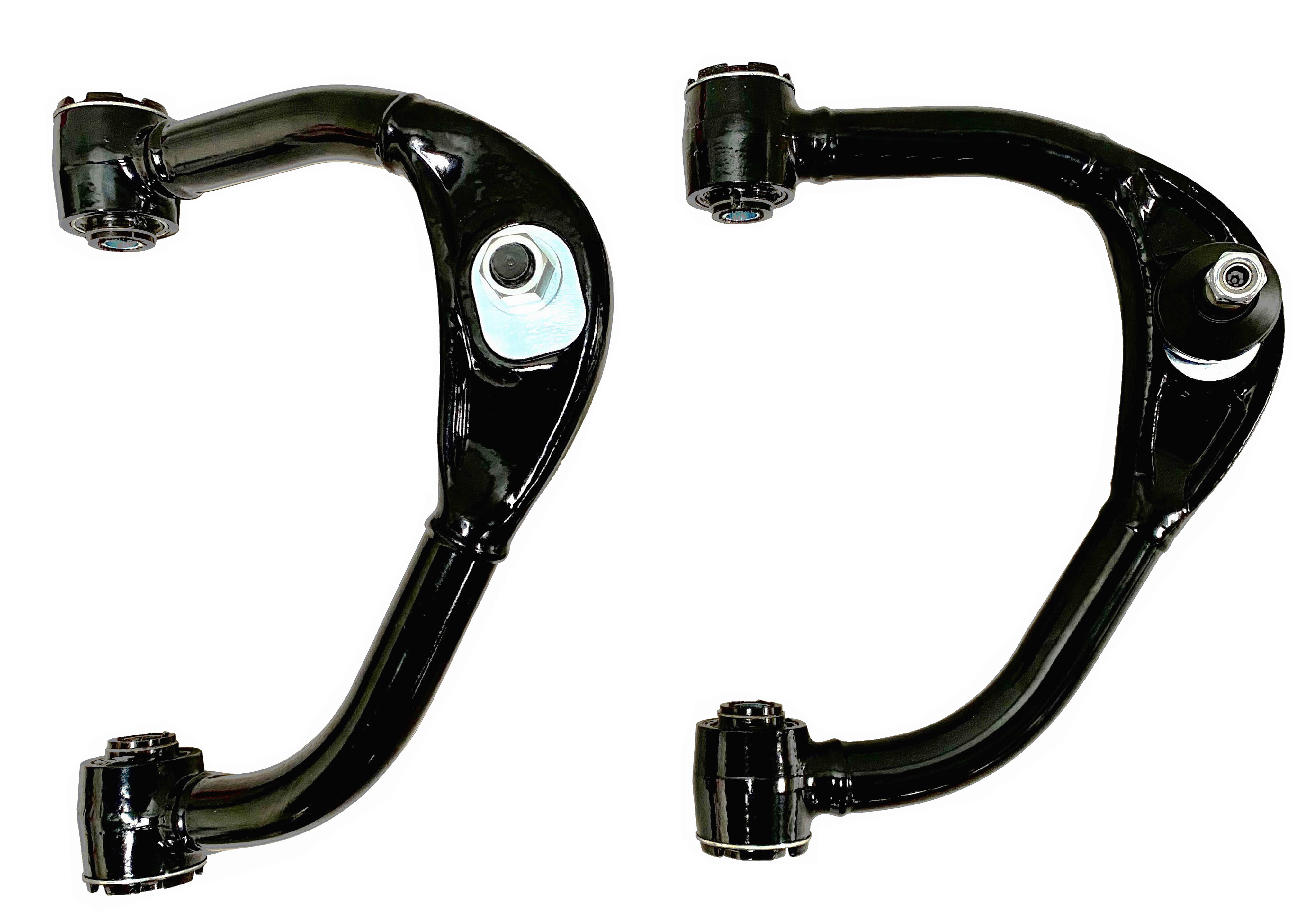
Front Front Control Arm - Upper Arm
✅ Fits 2016 GMC Canyon SLT Pre-OrderAvailable for Preorder. Ships within 4-6 weeks.Available for Preorder. Ships within 4-6 weeks.SKU: REV039.0082Front Front Control Arm - Upper Arm
✅ Fits 2016 GMC Canyon SLTPre-OrderAvailable for Preorder. Ships within 4-6 weeks.Available for Preorder. Ships within 4-6 weeks.Qty Required 1$349.87
Your vehicle
Matching vehicles
No match — try selecting it below.
Refine your search
Clear allCan’t find what you’re looking for?
Our team can help you find the right part — or tell us what was missing so we can improve the site.
Call Us +1 909-476-2860 Give Feedback (opens in a new tab)


